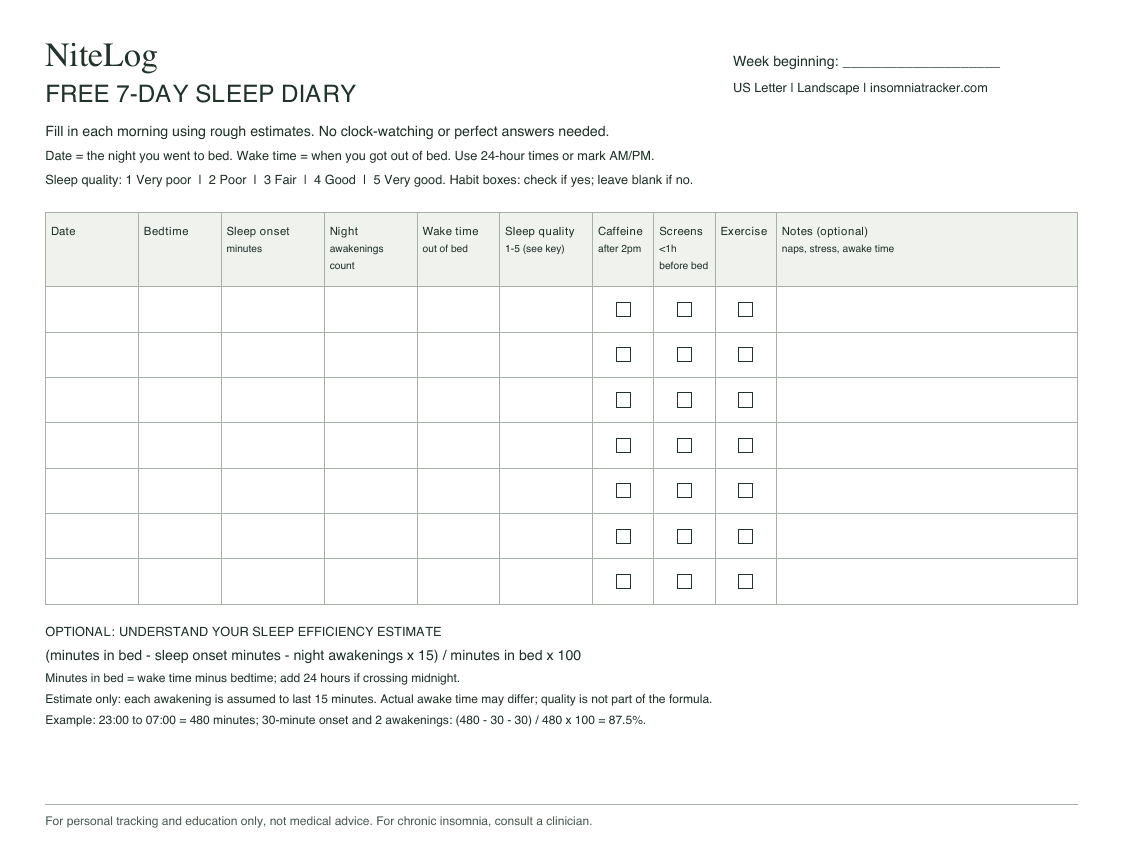
What is on the sheet?
Each of the seven rows has space for the date, bedtime, minutes to fall asleep, night awakenings, wake time, sleep quality, and notes. Use the date when you went to bed, even if you fall asleep after midnight. Wake time here means when you get out of bed for the day.
Quality is optional, with a plain-language key: 1 Very poor, 2 Poor, 3 Fair, 4 Good, 5 Very good. Each daily row also has three habit checkboxes: Caffeine after 2pm, Screens <1h before bed, and Exercise. Check a box if it applies; leave it blank if not. These are observations, not proof of what caused your sleep that night. The notes column lets you record things the online version does not have fields for, such as naps, caffeine timing, stress, or a long period awake. You do not need to complete every optional detail.
How to print and use it
Download and print
Load US Letter paper and download the PDF. Set your printer to landscape and actual size (100%). If your printer clips an edge, choose fit to printable area. The low-ink design also works in black and white.
Write a few notes after waking
Use rough estimates instead of checking the clock through the night. Write times in 24-hour format, or clearly mark AM and PM. Start with one to two weeks unless your clinician requests a different period; print another sheet for the next week.
Look back without grading yourself
Compare several nights, including how the night felt. A missed entry is fine. If tracking increases sleep anxiety, pause and ask your clinician whether a simpler approach would suit you.
The score is optional, and estimated
The sheet includes the same formula as our online tool: (minutes in bed − sleep onset minutes − night awakenings × 15) ÷ minutes in bed × 100. Each awakening is assumed to last 15 minutes; that may not match your actual awake time. Quality ratings are not part of the formula.
For times that cross midnight, add 24 hours before finding the difference. For example, 23:30 to 07:00 is 450 minutes. If the estimated awake time exceeds time in bed, check your entries instead of using a negative score. Neither a high nor a low percentage tells you whether you have a sleep disorder.
Paper or online: use what fits
Paper does not depend on browser storage and can be brought to an appointment. Keep completed sheets somewhere private, particularly if you share your home or workspace. NiteLog does not receive anything you write on them.
Prefer automatic estimates and a seven-record chart? Use the free sleep diary for insomnia in your browser. The PDF is a blank template, not an export of online entries, and it does not sync with the tool.
This tracking sheet is free. The companion book When You Wake in the Night is a separate paid product, not required to download or use it.